An illustrative example, with no real figures: a pharmacy distributor in Nairobi pays a manufacturer in Ahmedabad for a container of generic medicines. Neither party uses US dollars at home. In this example, the payment still converts Kenyan shillings to dollars, passes through a correspondent bank, and converts again to rupees. Each hop adds a fee, an exchange spread, and a compliance check, and none of the three banks involved can see the whole chain.
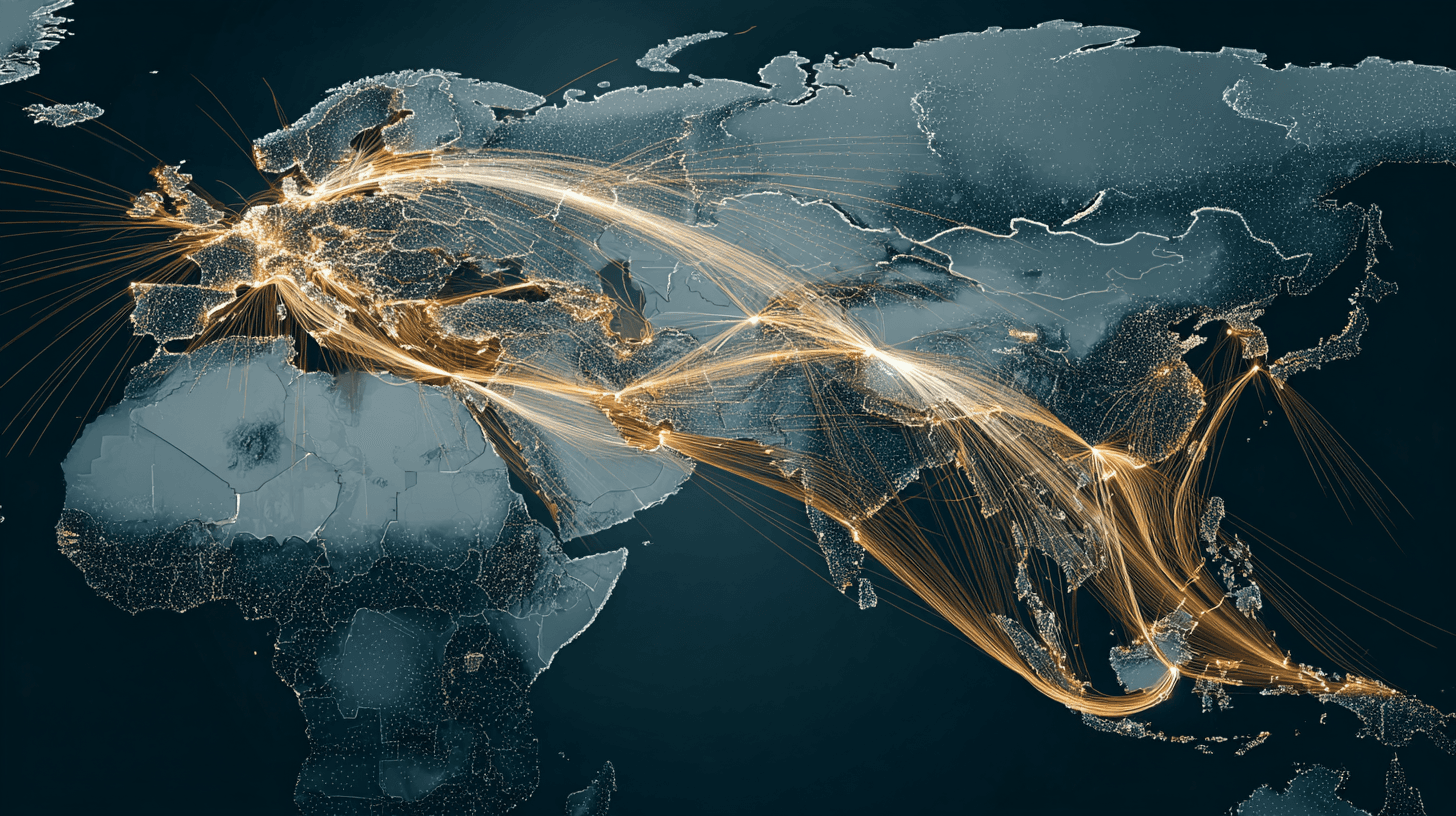
That route is the corridor's central problem. Trade between the Middle East, Africa, and Asia is large. The infrastructure that moves money, documents, and verification between them has gaps at every layer.
The size of the flows
China's customs administration reported China-Africa trade of about $295.6 billion in 2024, up 6.1 percent on 2023. India's commerce minister, Piyush Goyal, put India-Africa trade at about $82 billion in a 2025 speech.
Finance has not kept pace. The Asian Development Bank's Global Trade Finance Gap Survey, published in December 2025, puts the global trade finance gap at $2.5 trillion, about 10 percent of world trade and unchanged from its 2023 survey. For Africa alone, the African Development Bank's May 2026 report, Trade Finance Supply in Africa: Post-Covid Trends and Emerging Opportunities, estimates unmet demand for trade finance at $74 billion to $92 billion in 2024.
Gap 1: correspondent banking is shrinking
Cross-border payments between two banks with no direct relationship depend on correspondent banks in between. Those relationships have been falling for a decade. The Bank for International Settlements' payments committee reported in December 2021 that correspondent banking relationships worldwide fell about 25 percent between 2011 and 2020.
For a corridor between, say, a Tanzanian bank and a Bangladeshi bank, there may be no direct correspondent at all, so payments route through a dollar clearing bank outside both regions.
If you run a business that pays suppliers across these regions, map the actual route of your largest payments. Ask your bank how many intermediaries each one passes through, what each charges, and how long each holds the funds.
Gap 2: regional payment rails that do not connect
Each region is building its own answer. The pieces exist; the links between them are few and mostly bilateral.
- Africa: PAPSS. The Pan-African Payment and Settlement System, built by Afreximbank with the AfCFTA Secretariat, launched commercially in January 2022 with the six central banks of the West African Monetary Zone. It connects central bank settlement systems so African currencies can settle against each other without a dollar leg. By July 2026, Launch Base Africa reported, it covered 28 African countries after the Bank of Central African States joined.
- Arab region: Buna. The Arab Monetary Fund's Buna, launched in 2020, settles cross-border payments in six currencies: the UAE dirham, Saudi riyal, Jordanian dinar, Egyptian pound, US dollar, and euro. It has signed agreements to link with Pakistan's Raast instant payment system.
- India and the UAE: local currency settlement. In July 2023, the Reserve Bank of India and the Central Bank of the UAE agreed a framework for settling trade in rupees and dirhams and for linking their payment systems. In June 2026, India's ambassador to the UAE said more than 15 percent of bilateral trade had been invoiced in local currencies since the mechanism was formalized.
- Central bank digital currencies: mBridge. The Bank for International Settlements handed Project mBridge, a shared platform for central bank digital currencies, to its participating central banks in October 2024. China, Hong Kong, Thailand, and the UAE remain in it. The Financial Times reported in September 2026 that Saudi Arabia had ended its participation after completing a proof of concept.
For a Nigerian importer paying a Vietnamese supplier, or a Kenyan exporter selling to Indonesia, none of these rails covers both ends. Watch which links get built next, and design your treasury so you can switch routes when one appears.
Gap 3: banks cannot verify each other's customers cheaply
Before a bank in Dubai finances a shipment for a buyer in Lagos, it has to know the buyer, the buyer's bank, and often the seller. In established corridors, decades of relationships make that routine. In new ones, each check starts from nothing.
Afreximbank's response is Mansa, a shared due-diligence repository launched in 2018. African banks and companies upload standardized know-your-customer records once, and subscribing institutions draw on them. Global Trade Review has reported nearly 200 institutions onboarded, and has recorded a warning that KYC utilities elsewhere struggled with low uptake. A repository is only as good as the share of counterparties keeping their records current.
Gap 4: documents that are legal at one end only
An electronic bill of lading is only as good as its legal standing at each end of the voyage. On UNCITRAL's list of jurisdictions that have adopted its Model Law on Electronic Transferable Records, the Middle East is represented by Bahrain (2018) and Abu Dhabi Global Market (2021). The only African entry is Mauritius (2025), and its law covers bills of exchange only. On a Gulf-to-East Africa route, a shipment can leave under a recognized electronic document and arrive where that recognition is uncertain. Ask a trade lawyer in each country on your route before you drop paper.
Gap 5: shipments go dark after the port
Ask where your own shipments go dark. On routes into African inland markets, check three points first: customs status in destination ports where systems have no open interface, inland trucking after clearance, and handoffs between forwarders on different legs. A delay at one port shows up downstream with no record of its cause.
The fix is often unglamorous. Agree a shared shipment identifier with every party on the route, and require each forwarder to post status events against it, even by message or spreadsheet. Data you can join across legs is worth more than a dashboard covering one.
Where builders can hold a position
- Specialize by corridor. A Kenya-India pharmaceutical route has different licensing, documents, and payment needs from a Vietnam-Nigeria textile route. A platform that knows one corridor in depth is harder to displace than one that covers every route lightly.
- Collect transaction data from day one. Each completed trade adds evidence on buyer payment behavior, clearance times, and carrier performance. That record is what later lets you price risk, predict delays, or underwrite finance.
- Build regulatory relationships country by country. Payment, customs, and data rules differ in every jurisdiction on the route. Software does not substitute for licenses and local counsel.
Start with one corridor you already trade on. For your last ten shipments, write down how the money moved, which documents were paper, where verification stalled, and where the shipment went dark. Fix the layer that cost the most days first.
GradeCircle builds and runs six products of its own: AfroSynergy, CallerBridge, HealthSquire, Heyzl, Lexfora, and LukeAPI, two of them in beta. The assumptions in our models come from operating those systems, not from a framework. See what we run.
If you are building or scaling in these markets, see how GradeCircle approaches AI implementation.